
This collaborative NZaid project worked with coastal Fijian villagers at Votua on the Coral Coast of Viti Levu to develop pragmatic water supply and waste treatment solutions to protect public health and reduce contamination of coastal waters.
Problem
Votua is a coastal village of around 300 people situated on the Coral Coast of Viti Levu, one of the main tourist regions of Fiji.
Recent studies have shown that the discharge of raw and poorly treated wastewaters from villages along the Coral Coast have caused deteriorating coastal water quality (excess nitrogen and increased levels of faecal bacteria) in the area, threatening the sustainability of the reef and its fisheries.
Expanding tourism, rapid population growth in Fijian villages (around 2.7 percent per year), the expansion of piped drinking water supplies along the coast and the introduction of flush toilets without installation of suitable treatment and disposal systems, have all increased the flow of wastewater into the coastal area.
As a result, the health and livelihoods of the communities living along the coast are being adversely impacted, and there is a substantial ongoing risk to the future of the local tourist industry.
NIWA-led studies have found that faecal and nutrient contamination loads into rivers and coastal waters on the Coral Coast are expected to increase by over 30 percent in the next ten years unless appropriate wastewater management is implemented.
Solution
To help protect the community's health and reduce the levels of contaminated water discharging into the surrounding coastal waters, a four-year project was launched under the New Zealand Aid Programme to develop sustainable, practical solutions to treat and dispose of wastewaters in coastal Fijian villages, using Votua as a test case.
The project addressed the village's water supply, sanitation, human health and hygiene, and environmental protection needs using a participatory approach in which the team worked very closely with the villagers.
The aim of the project was to strengthen the capacity of the local community to understand the linkages between hygiene, proper water and waste management, and the health of their families and environmental resources. With this in mind, a system could be developed which would integrate with the infrastructure already in the village, be simple for the community to operate, and easy for other villages to copy and learn from. It was critical to the project's success that the solutions were embedded into the community in such a way that ongoing costs and maintenance requirements were low and achievable.
During the project a skilled group of local workers was trained to construct, operate, and maintain their own water and wastewater infrastructure. The villagers were involved in planning decisions about the system and how it would best be implemented, providing valuable local and traditional knowledge. The village provided communal labour at key times to bring the project to fruition, and took communal responsibility for feeding the workers who had come from outside the village.
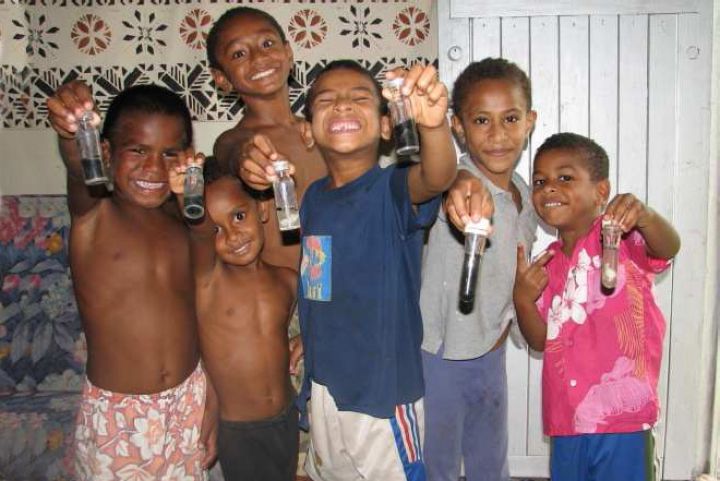
Water quality was monitored, with the help of the local population, to identify contaminant sources and assess health and environmental risks. As part of this, people were also asked to photograph what they considered to be "healthy" and "unhealthy" parts of the village, and discuss this at workshops to create local engagement with the issues.
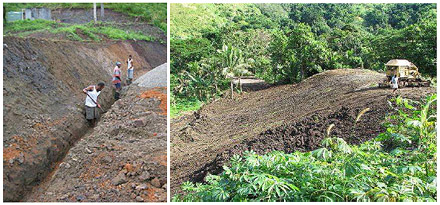
A new water supply and reticulation system was designed and built in the village. This used surface water with a new intake filter and settling tanks, fed into a new village ring main, supplemented by rainwater collection. Water meters were also used to monitor water usage and black and grey water generation in the village.
The new wastewater system separates black water (toilet waste) from the grey water generated through household activities. Black water carries most of the pathogens and excess nutrients but comprises only 20% of the total village effluent. Black water from the village is treated in septic tanks linked to a wetland treatment system built in the valley behind the village where there is available land, and low permeability clay soils to seal the base. This system also supports the commercial growing of Bird of Paradise flowers. The disposal of grey water uses coconut husk pre-filters followed by soil and sand infiltration.

Results
"This Project greatly enhances the environmental management work being undertaken by Votua to preserve and protect our marine resources," said Kini Ravonoloa, an Environmental Committee Representative from Votua. "We are truly thankful for the great assistance provided by New Zealand's Aid Programme and hope that other villages and coastal developments in Fiji will follow our lead and work to eliminate wastewater pollution."
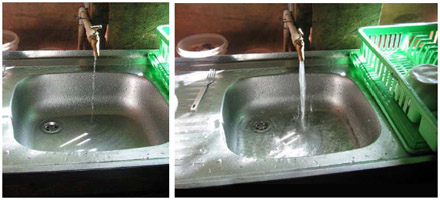
All 57 houses in the village have a greatly improved water supply and sewage treatment. Villagers now use tap water, rather than contaminated water from the nearby creek, for bathing and household chores. Greywaters from kitchens, bathrooms and laundries are passed through coconut husk filters before being infiltrated into sandy soils, or treated in wetland gardens. Septic tanks have been installed along with pump stations and sewerage pipes for toilet effluents, and a wetland treatment system now effectively treats these wastewaters.
Discharge of organic matter, suspended solids, nutrients and microbial contaminants are greatly reduced by the new treatment facilities, reducing human health risks and impacts on the environment. Treated effluent from the village is re-used instead to grow flowers and taro leaves, and its use in fish ponds is also being trialled. This creates opportunities for income generation as well as delivering health and environmental benefits.
The community participation in identify health risks and monitoring water quality led to greater awareness of the high level of illnesses from water borne diseases and the situations that were leading to them.
Three hundred people in Votua village now have access to improved water and sanitation systems. This is expected to reduce the health risk of waterborne diseases associated with inadequate water supplies and the discharge of grey and blackwaters into nearby streams used for bathing, laundry and recreation.
The waste management systems developed, which were constructed and maintained using local village labour and natural resources, were new innovations not seen before in Fiji or the Pacific Islands.
As a result of the project's success, Wai Votua has attracted widespread interest from neighbouring villages and Fijian agencies. The project has prompted a similar project in the neighbouring village of Qalito, and further projects are also underway in other villages along the Coral Coast, funded by New Zealand Aid and the Rotary Pacific Water for Life Foundation.
The project took place from 2006-2010.
Partners and funders
The project involved three NZ agencies, NIWA (National Institute of Water and Atmospheric Research), ESR (Environmental Science and Research), and Christchurch engineering consultancy ecoEng Ltd working in close collaboration with the Institute of Applied Sciences at the University of the South Pacific. It was funded via the former Ministry of Research Science and Technology through the NZAID Government Agencies Contestable Fund.