
Few New Zealand lakes retain their indigenous vegetation, and the condition of many lakes is under threat from land-use changes and the invasion of alien aquatic plants.
LakeSPI (Submerged Plant Indicators) is a bio-assessment tool that uses carefully selected features of submerged plant vegetation to monitor change and assess the ecological condition of New Zealand lakes.
Historically, lake condition has been monitored by full vegetation surveys and/or physicochemical open-water sampling methods. These methods can be complex, costly and time-consuming and, as a result, lake monitoring is often done irregularly or not at all.
LakeSPI (pronounced 'spy') aims to simplify the monitoring process. Submerged plants are highly suitable biological indicators of change within a lake as they are easy to observe, reflect environmental conditions over an extended period of time and bring focus to the shoreline of a lake where the greatest public interaction occurs. As a result, LakeSPI enables regular monitoring of a wider suite of lakes than is currently possible and has proven to be a useful complement to traditional lake monitoring methods.

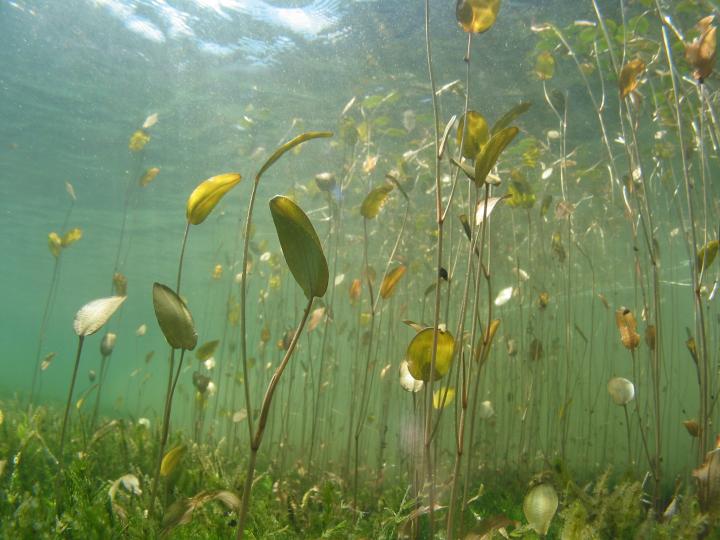
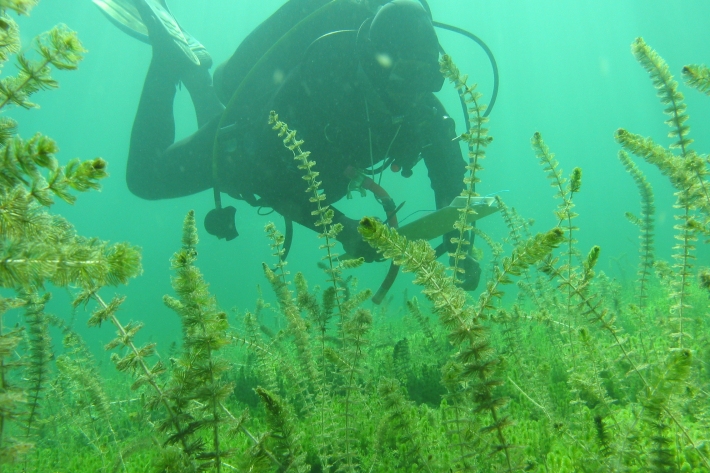
LakeSPI is carried out using scuba diving to record key features of aquatic plant structure and composition within a lake. NIWA scientists use the survey data to generate three LakeSPI indices: Native Condition Index, Invasive Impact Index and LakeSPI Index. The LakeSPI method assumes native plant species and high plant diversity represent better lake health or condition, while invasive plants are ranked for undesirability based on their displacement potential and ecological impact.
More than 300 lakes have been assessed using LakeSPI.
Lake managers and other interested parties can find out more about the indices, freely view report cards for individual lakes or compare results on a national or regional level at on the LakeSPI website.
-

How LakeSPI works
LakeSPI (Lake Submerged Plant Indicators) is based on the principle that New Zealand lakes can be characterised by the composition of native and invasive plants growing in them, and the depths to which these plants grow. -

Submerged plants as bio-indicators
Submerged plants have a number of advantages that favour their use as indicators of lake ecological condition. -
Uses of LakeSPI
LakeSPI can be used in many ways depending on what the interests or management needs are for a lake. -

Reporting guidelines
LakeSPI delivers information that is directly applicable to lake-ecosystem conservation and management. -

LakeSPI outputs
LakeSPI (pronounced ‘Lake Spy’) provides a quick and cost-effective tool for monitoring lake condition.