Tench
Tinca tinca (Linnaeus, 1758)
This member of the Cyprinidae family is native to Europe and was first introduced to New Zealand in 1867. Although imported as a sports fish, there has been little angler interest in tench until recently. Tench grow to a large size in New Zealand, and some northern lakes have now gained an international reputation among anglers who prefer fishing for coarse fish. Fish over 2 kg in weight are not uncommon, and in some instances 4-kg fish have been caught.
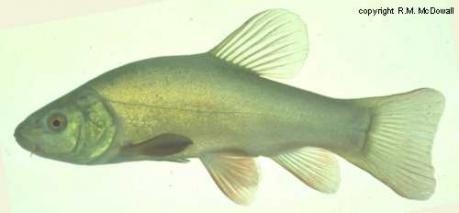
Tench are generally an olive green colour although this varies from dark to light. There is a single small barbel at each corner of the mouth. The fins tend to be thick and fleshy and the body is covered in small scales. Their eyes are bright orange, and this is their most distinctive characteristic.
The biology of tench in New Zealand has not been studied, but is probably similar to that of fish in their native waters. Tench generally live in still or slow-flowing waters and are carnivorous, feeding mainly on crustaceans, molluscs and insect larvae. Males have longer and fatter pelvic fins than females. Spawning occurs in spring and summer and, like all the Cyprinidae, tench are prolific breeders; a large female may produce hundreds of thousands of small eggs.
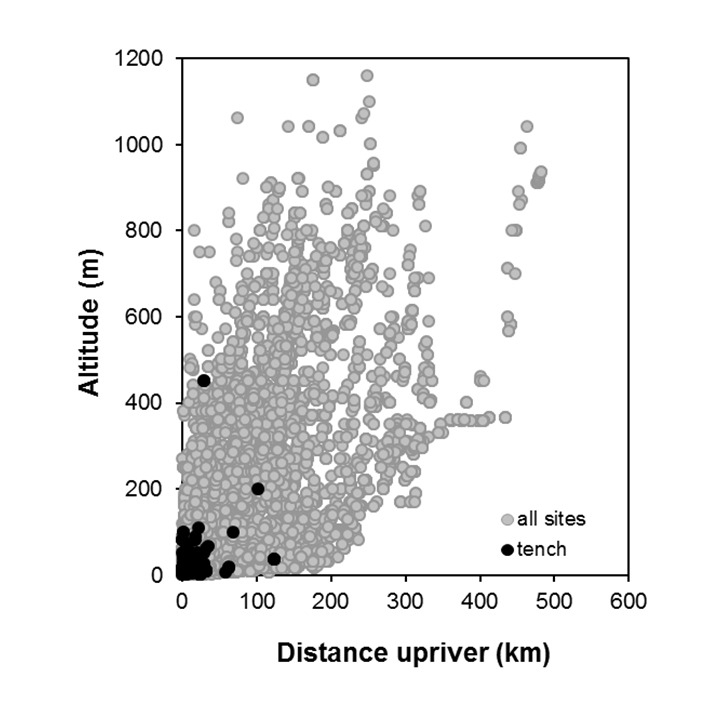
Although most fishing for tench occurs in the Auckland area, tench are also present in some lakes and ponds in Northland, Tauranga and Wellington. They have been present in the South Island near Oamaru for many years, but have also been found recently in Nelson, Marlborough and Canterbury during recent surveys by the Department of Conservation. A golden variety of tench, which is bright yellow-orange, is thought to be present in some small lakes and ponds near Auckland. This variety of tench was illegally imported in about 1980.
![Tench distribution map [2024]](/sites/default/files/styles/wide/public/2024-02/Tench.jpeg?itok=HIOmvs3D)