Rudd
Scardinius erythrophthalmus (Linnaeus, 1758)
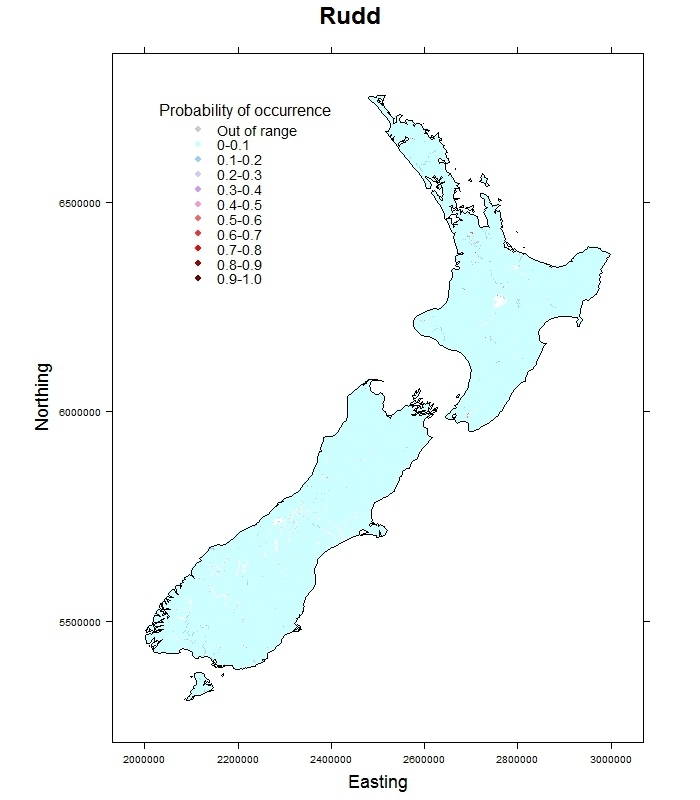
This member of the Cyprinidae family is native to Eurasia and was illegally imported to New Zealand in 1967. Stock bred from this importation was subsequently widely released and rudd are now well established in many North Island waterways, particularly in the Waikato River catchment. Rudd have also been recorded around Christchurch, and more recently from other parts of the South Island.
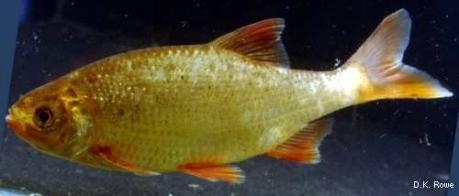
Like goldfish, rudd do not have any barbels around their mouth, a feature that tells them apart from koi. They can be distinguished from goldfish because they lack the stout spines on the front edge of the dorsal fin, and from orfe by the projections that occur at the bases of their pectoral and pelvis fins. Rudd can also be confused with perch, but perch have two dorsal fins, the first with several firm spines. Rudd are darker on their backs than on their bellies and have bronze highlights when the light catches their scales. Their fins are usually bright reddish orange.
Juvenile rudd are planktivorous, but as adults their diet consists mainly of aquatic plants. As a herbivore, rudd are likely to have a role in supressing the regeneration of aquatic plants in lakes and hence in maintaining poor water quality. A high-density rudd population ruined the trout fishery in an Auckland lake becuse they outcompeted trout for anglers lures. This suggests their introduction into new waters could be detrimental to fish and native plant communities as well as to water quality.
Like all the Cyprinidae, rudd are prolific breeders and large females can produce literally hundreds of thousands of eggs. The largest rudd ever recorded was over 400 mm in length, but fish 200–250 mm in size are much more common.
![Rudd distribution map [2024]](/sites/default/files/styles/wide/public/2024-02/Rudd.jpeg?itok=plP_6gas)