Redfin bully
Gobiomorphus huttoni (Ogilby, 1894)
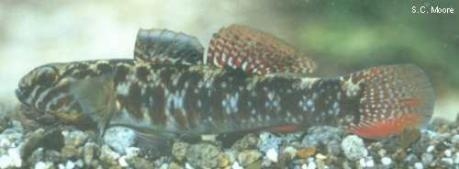
The bright red fins of an adult male redfin have to make this one of New Zealand's most attractive freshwater fish. Although only males get this distinct colouration, the diagonal stripes on the cheeks make the redfin bully easy to identify. These stripes are even visible in small bullies from about 30 mm in length.
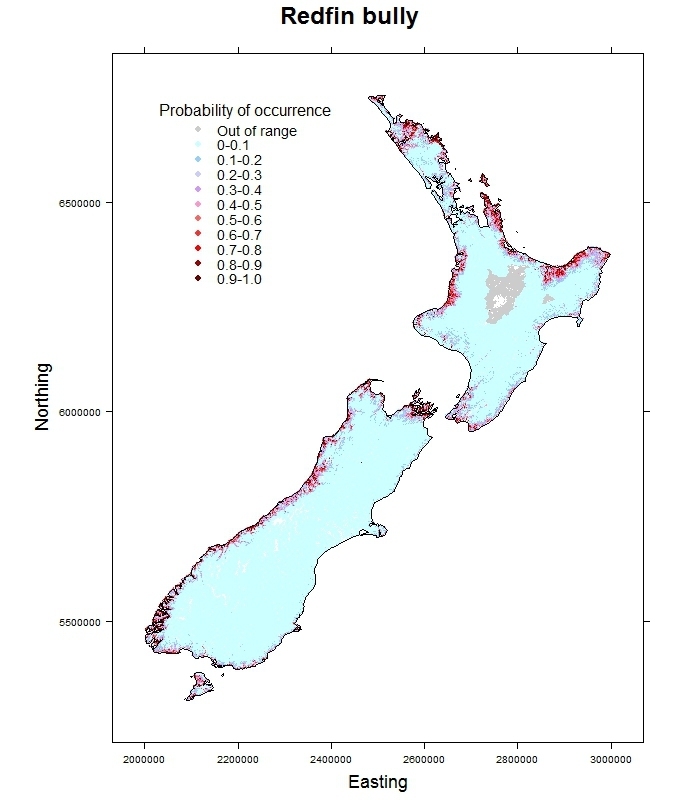
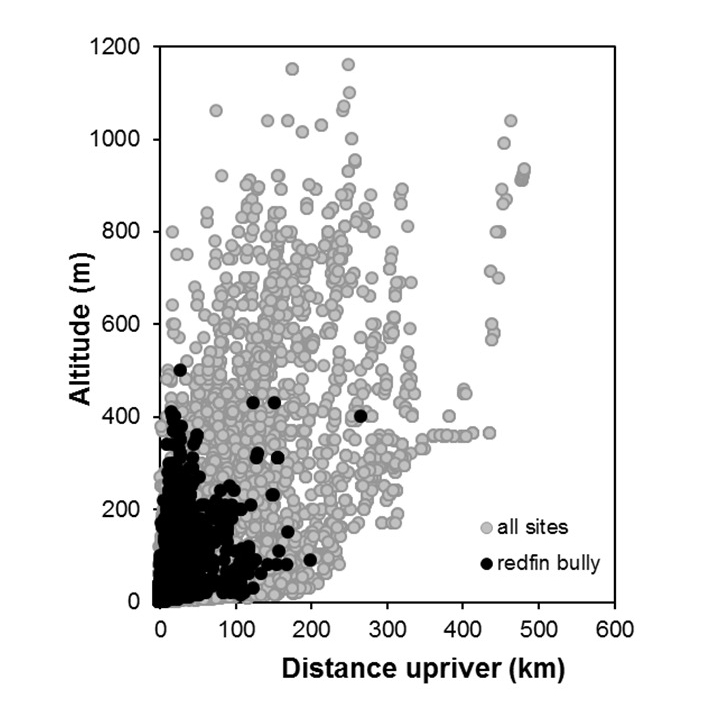
Redfin bullies are strictly diadromous and do not establish land-locked populations. Thus, they tend to live near the coast even though they are very good climbers (populations above 5-m-high waterfalls have been recorded). Spawning takes place in fresh water and after hatching the larvae are swept out to sea. The juveniles enter fresh water in the spring and reach maturity about two years later. This diadromous habit means that they are widespread throughout the country and have been frequently recorded from Chatham and Stewart Islands. However, they are rare along the east coast of the South Island above Oamaru, except for Banks Peninsula.
Redfin bullies occur mainly in the runs and pools of small bouldery streams and their principal food is mayfly, caddis fly and chironomid larvae. Becuase of their dependance on this habitat, they are more sensitive to the effects of siltation in streams than other fish species.
The redfin bully was recognized as a distinct species as early as 1894, but it has had many name changes over the years. The present specific name huttoni honours one of New Zealand's early biologists, Sir Frederick W. Hutton, who was a director of the Canterbury Museum from 1892 to 1905.
![Redfin bully distribution map [2024]](/sites/default/files/styles/wide/public/2024-02/Redfin%20bully.jpeg?itok=KG17WWGL)