Gambusia
Gambusia affinis (Baird and Girard, 1854)
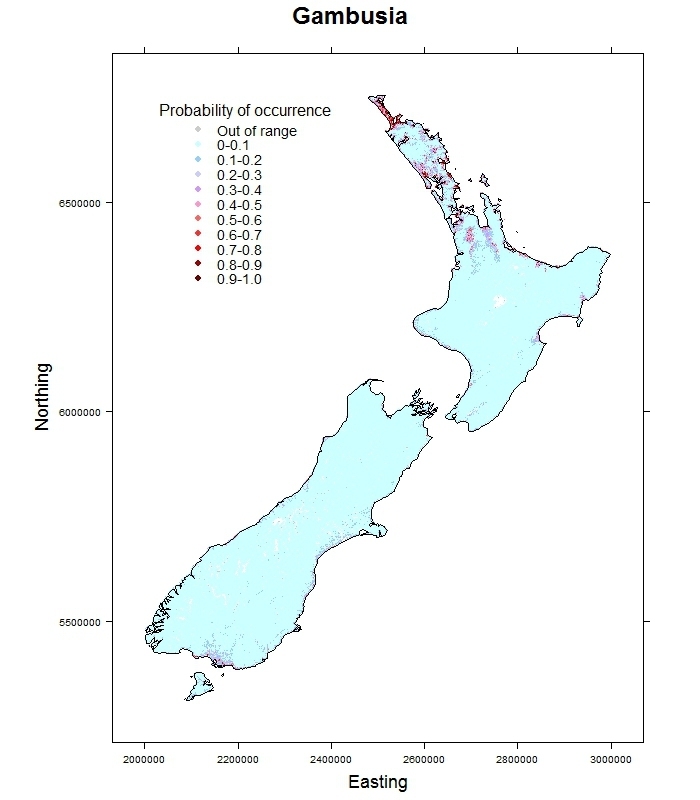
In their native waters surrounding the Gulf of Mexico, gambusia are renowned for their ability to eat large numbers of mosquito larvae and are also commonly called mosquitofish. This ability led to their introduction into many countries where mosquitoes were perceived to be a problem, resulting in gambusia possibly being the most widespread fish in the world today. Their arrival in New Zealand is not well documented, but probably occurred in the 1930s when a population was established in an Auckland pond. Since then, they have been steadily spread thoughout the North Island. A number of wild populations were discovered around Nelson after 2000 but most of these have now been erdicated to restrict its spread in the South Island.
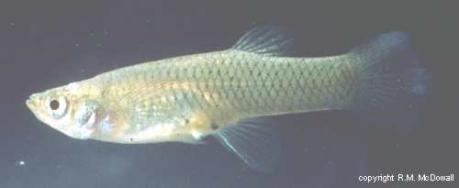
Compared to some of the other Poeciliidae, gambusia are rather drab, although the darker margins on their scales give them a crosshatch pattern. Gambusia are relative small fish: females may reach 60 mm in length, but males are usually less than 40 mm. Mature females often have a large black blotch behind the operculum and mature males are charactersied by their elongated pelvic fins which from a gonopodium.
Gambusia makes up for its small size by being an extremely aggressive species and attacks on some native fish species have been well documented globally as well as in New Zealand. Overseas, they have also reduced a number of frog and dragonfly species. Their value as a mosquito control agent is questionable and clearly they are an unwanted species so their spread should be prevented.
![Gambusia - distribution map [2024]](/sites/default/files/styles/wide/public/2024-02/Gambusia.jpeg?itok=6hqeCIQA)