
Grayling
Prototroctes oxyrhynchus (Günther, 1870)
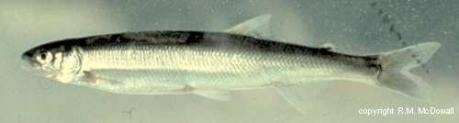
Most New Zealanders are well aware that some of our native bird species, such as the huia and moa, are now extinct. Few also know that the same is true of one of our native fish species, the grayling. This fish, which is closely related to the smelts, was the only member of the Prototroctidae family in New Zealand. Today, there are probably only a couple of dozen specimens in existence, carefully preserved in museum collections. Fortunately, a closely related species still lives in Australia and studies on this grayling have given us some insight into our own species.
The grayling commonly grew to 200–400 mm in length and was a shoaling species like the common smelt. It was widespread and common in the early 1800s, and appeared to reside in lowland rivers and streams during summer, autumn, and winter. It was New Zealand's only herbivorous fish, grazing on the periphyton present on rocks and boulders. Its life cycle was probably similar to that of the whitebait species and common smelt, with the fish growing and spawning in fresh water, and the newly hatched larvae being washed out to sea to live for several months before migrating back to rivers.
Grayling numbers began to decline soon after Europeans arrived in New Zealand, and as early as the 1870s biologists were expressing concern about their decline. In 1930, they were officially described as being on the verge of extinction by the Marine Department. Why the grayling became extinct is a mystery, but the introduction of trout and widespread forest clearance that rapidly followed European settlement are thought to have contributed to their demise.
![Grayling - distributions map [2024]](/sites/default/files/styles/wide/public/2024-02/Grayling.jpeg?itok=oQB9Ros1)