
Grass carp
Ctenopharyngodon idella (Valenciennes, 1844)
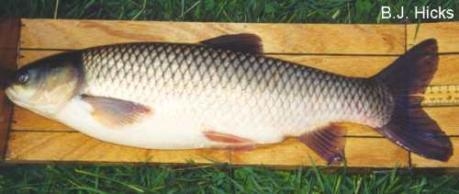
Grass carp were first brought to New Zealand in the 1960s because of their potential to control the growth of aquatic plants. Unlike the other introduced fish brought to New Zealand, the potential value and impact of grass carp was investigated in secure facilities prior to their use in field trials. Although these fish mature, they have extremely specific spawning and rearing requirements and the establishment of a wild population is extremely unlikely.
There has been much controversy surrounding the use of grass carp as a weed control agent in New Zealand. So far, the main value of grrass carp in New Zealand has been to eradicate problem weed species from lakes, thus allowing native plant communities to re-establish. This means they have a role to play in lake restoration, as well as weed control, but their use for weed control in drains is still being investigated. Today, stocks of grass carp are maintained for breeding at a private hatchery north of Auckland.
Grass carp are a large and robust fish. They commonly exceed 500 mm in length, 10kg in weight, and can live for 15-20 years. Their backs are a dark bronze colour, but this gradually fades to silver on the belly. The margins of their large scales are outlined in a darker colour, giving them a crosshatched appearance. Grass carp have no barbels, but can be distinguished from goldfish by the short dorsal fin with only 7–9 rays.
![Grass carp - distribution map [2024]](/sites/default/files/styles/wide/public/2024-02/Grass%20carp.jpeg?itok=0OGpuUhM)