
Dwarf inanga
Galaxias gracilis (McDowall, 1967)
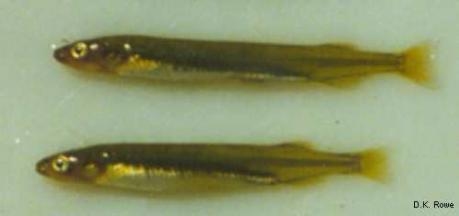
The dwarf inanga looks like a small inanga and is closely related to inanga. However, it is found in only 13 lakes near Dargaville in the North Island. As its name implies, it is the smallest member of the Galaxiidae family in New Zealand. Specimens of over 80 mm in length are rare, and mature adults may be only 40 mm.
Juveniles school around the lake edges where rushes and macrophytes provide shelter from predators. They feed on zooplankton in open waters at night. Adults occur in deeper water near the middle of the lake and return to the littoral zone at night to feed on the larger invertebrates present there
Dwarf inanga populations have declined over the past 30 years, and it is now considered to be a threatened species. The introduction of rainbow trout into some of the lakes it inhabits (especially the Kai Iwi lakes) was initially blamed for this decline, as trout are known to eat inanga. However, removal of trout from one lake did not increase the abundance of dwarf inanga and, up until 2000, it was abundant in Lake Ototoa which was routinely stocked with trout. Gambusia is now thought to be responsible for its scaricty in Lakes Taharoa nd Waikere, and for its extinction in Lake Kai Iwi.
![Dwarf inanga - distribution map [2024]](/sites/default/files/styles/wide/public/2024-02/Dwarf%20inanga.jpeg?itok=mx_iFOec)