Common smelt
Retropinna retropinna (Richardson, 1848)
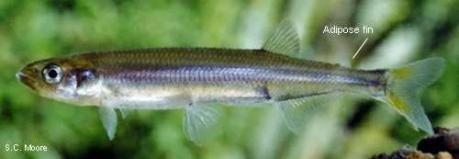
There are two New Zealand species in the Retropinnidae family, the common smelt and Stokells smelt. This family of fishes, known as the southern smelts, is also found in Australia, but the two species we have here are unique to this country. Smelt can be distinguished from other species by the presence of the adipose fin, a small fleshy lobe on their back between the dorsal fin and the tail. They also have scales, a distinctly forked tail, and a cucumber-like smell. The two species that live in New Zealand are very difficult to tell apart, and positive identification depends primarily on the size and number of the scales.
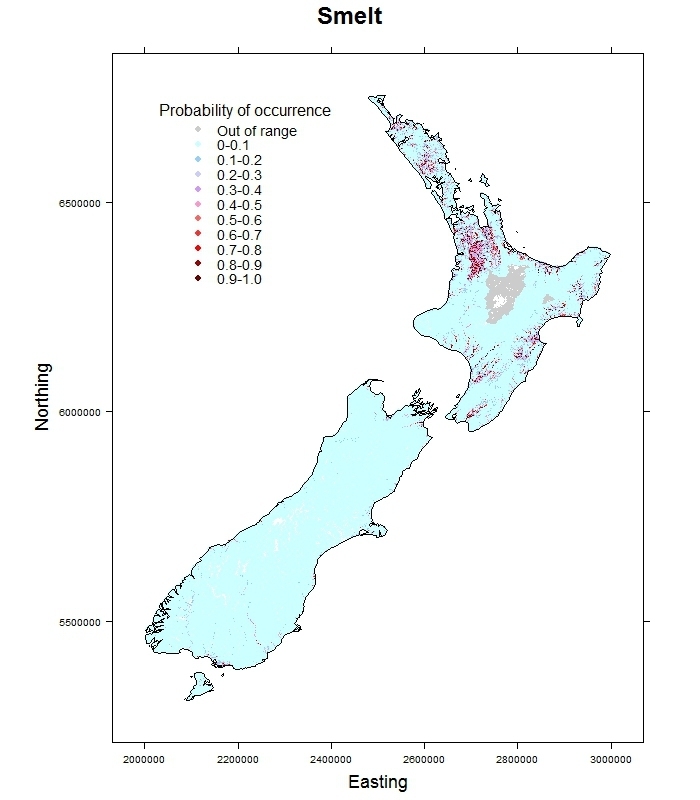
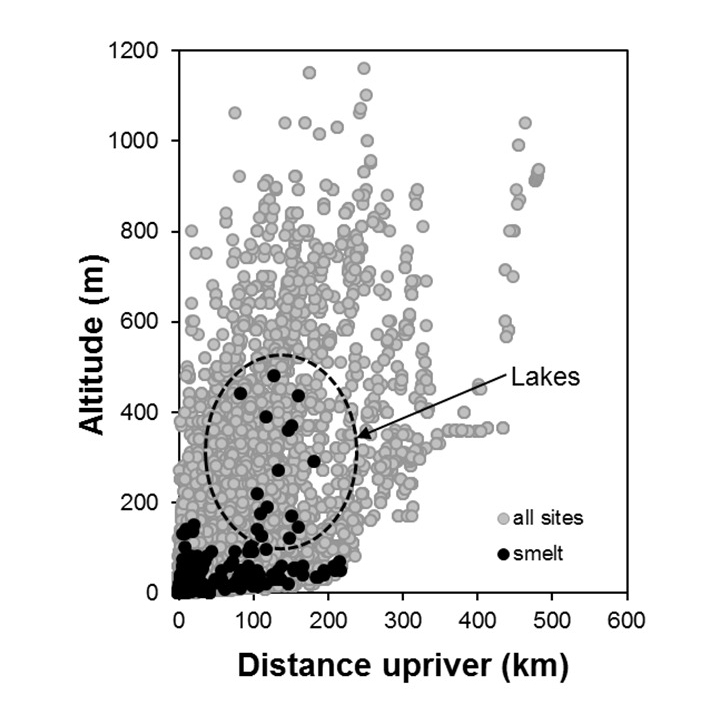
Smelt are a shoaling species, which means they swim in schools near the water surface rather than resting or hiding on the substrate. Thus, they are often seen out in the open in streams and lakes as they feed on drifting food organisms. The common smelt is widespread throughout New Zealand, including Stewart and Chatham Island. They live in flowing and still water, and there are both diadromous (sea-going) and non-diadromous (land-locked) populations in New Zealand, although humans have established many of the latter. Although they are not a climbing species, smelt are good swimmers and will penetrate well inland in river systems that are not too steep (e.g. the Wanganui or Manawatu Rivers). They are particularly abundant in the Waikato River catchment.
Of the freshwater fish that live in New Zealand, smelt are one of the most sensitive to pollutants like ammonia and stressors such as high water temperature. In some cases, they are as intolerant as the salmonids, which are often used as a benchmark species overseas for establishing water quality guidelines to ensure fish are protected from human activities. Smelt are therefore an appropriate native species for establishing guidelines for New Zealand waterways and usually their presence indicates that the water quality is suitable for most other fish.
In most North Island lakes, smelt are the main prey species for trout. In rivers, juveniles are often captured by whitebaiters as they migrate upstream and mix with the whitebait (galaxiids).
![Common smelt - distribution map [2024]](/sites/default/files/styles/wide/public/2024-02/Common%20smelt.jpeg?itok=CJDcyrsy)