
Brown bullhead catfish
Ameiurus nebulosus (Lesueur, 1819)
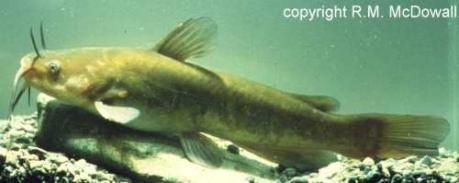
The catfish is not native to New Zealand and is the only member of the Ictaluridae family that occurs in New Zealand waters. The Ictaluridae, or North American catfish, is one of the smallest of more than 30 catfish families worldwide with about 45 species. Ictalurids are characterised by having barbels around the mouth – these look rather like whiskers and hence the common name catfish. However in North America, where there are many species of catfish, the species found in New Zealand is known as the brown bullhead.
The brown bullhead catfish is dark brown to olive green colour with paler sides and bellies. In addition to the eight distinctive barbels around their mouth, catfish also have relatively small eyes and a smooth skin. The leading edge on their dorsal and pectoral fins has a sharp spine, and thus catfish should be handled very carefully to avoid injury from the spine. Catfish are an extremely robust fish and can survive for long periods out of water. They commonly grow to 200–300 mm in length.
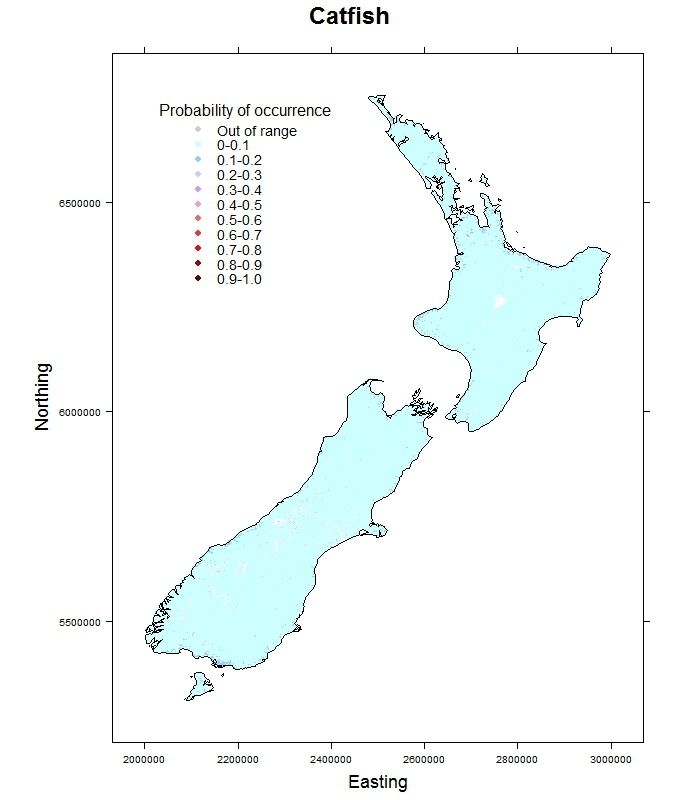
Catfish have been present in New Zealand since the late 1800s. For many years, they were rarely encountered with the only known populations occurring in the lower Waikato River and in Lake Mahinapua south of Hokitika. They were first recorded from Lake Taupo in 1985. Since then, catfish have gradually spread throughout Lake Taupo and down the Waikato River. In 1997, catfish were recorded for the first time from the Kaituna Lagoon near Lake Ellesmere, and in 2003 from a stream entering Hokianga Harbour. Accidental introductions via boat trailers and especially fyke nets used for eeling is continuing to spread this species around New Zealand.
Catfish spawn in shallow depressions on the substrate in the shallows. The male guards and fans the eggs during development, and also guards the larvae for about a week after hatching. Catfish are carnivorous and use their sensitive barbels to probe the substrate and locate insects, crustaceans, molluscs and small fish. Freshwater crayfish are a major prey species for catfish in Lake Taupo.
![Brown bullhead catfish - distribution map [2024]](/sites/default/files/styles/wide/public/2024-02/Catfish.jpeg?itok=kc5UlHIp)
![Catfish_Ameiurus nebulosus_penetration [2024]](/sites/default/files/styles/wide/public/2024-02/Catfish_penetration_Ameiurus%20nebulosus_penetration_0.jpg?itok=7ppRUCVG)