
Brook char
Salvelinus fontinalis (Mitchill, 1814)
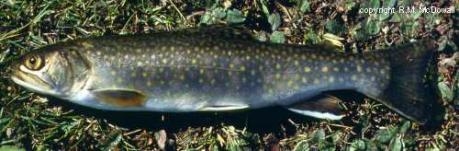
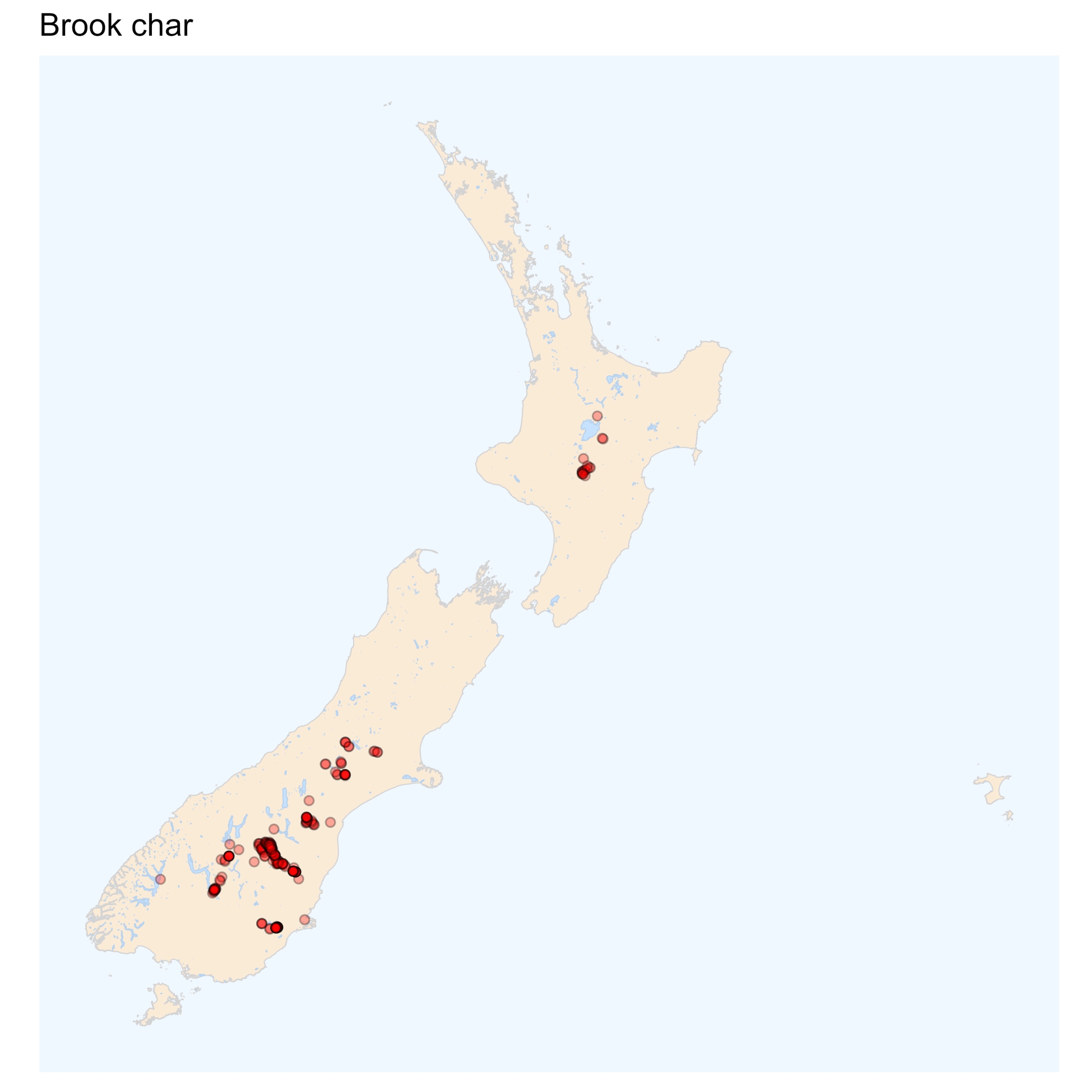
This native of the eastern North American continent was first introduced to New Zealand in the late 1870s or early 1880s. Brook char have been released in virtually all the main catchments on the east coast of the South Island, and they were also widely introduced in the North Island although they now occur in only 3-4 rivers in the Central North Island. Although many populations have now become established in the South Island, river-dwelling brook char are confined to the very small tributaries where they do not have to co-exist with other salmonids. Here they can reach maturity, but they tend to be stunted (small in size) and thus are not usually fished for. Several lake populations have also become established, and these are more popular with anglers. In particular, Lake Emily in the Ashburton River catchment yields brook char up to 2 kg in weight.
Brook char are an attractive, brightly coloured member of the Salmonidae family. In fact their colouration is a good characteristic to use to distinguish them from the other salmonids. Their bodies are generally dark with marbling present on the back. Their sides are covered with gold and red spots, the latter of which are surrounded by pale blue halos. In addition, there is a distinctive white stripe followed by a contrasting black stripe on the leading edge of the pelvic, pectoral and anal fins. Brook char also have a very large mouth that extends back behind the posterior margin of the eyes.
![Salvelinus fontinalis_penetration - distribution map [2024]](/sites/default/files/2024-02/Salvelinus%20fontinalis_penetration_0.jpg)
Download PDF Download