
Bluegill bully
Gobiomorphus hubbsi (Stokell, 1959)
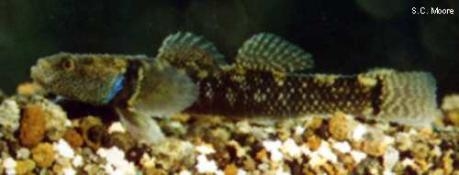
The bright blue gill cover just behind the head readily distinguishes the aptly named bluegill bully from other members of the Eleotridiae family. Small dark spots that cover their cheeks are another useful characteristic. When viewed from the top bluegill bullies are arrow shaped, with their narrow elongate body trailing behind the larger head.
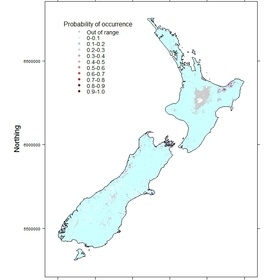
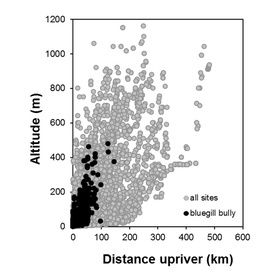
Bluegill bullies inhabit similar habitat to torrentfish - swift broken water in open rivers and streams. They also have a similar distribution pattern to torrentfish, being absent from Fiordland, Stewart and Chatham Island, and rare in Otago and Southland. Overall, they are not as common as torrentfish, particularly in Taranaki and Coromandel.
Bluegill bullies are the smallest members of the Eleotridiae family in New Zealand. The largest specimen recorded is a 100 mm bully, but most adults are between 60–70 mm in length. In common with all the bully species, bluegill bullies are benthic. Bluegill bullies are strictly carnivorous, and their food is mainly mayfly larvae. Males grow larger than the females and the larger fish (both sexes) are found further upstream than the smaller ones.
![Bluegill bully - distribution map [NIWA]](/sites/default/files/styles/wide/public/2024-02/Bluegill%20bully.jpeg?itok=NfcMpt-x)
Download PDF Download