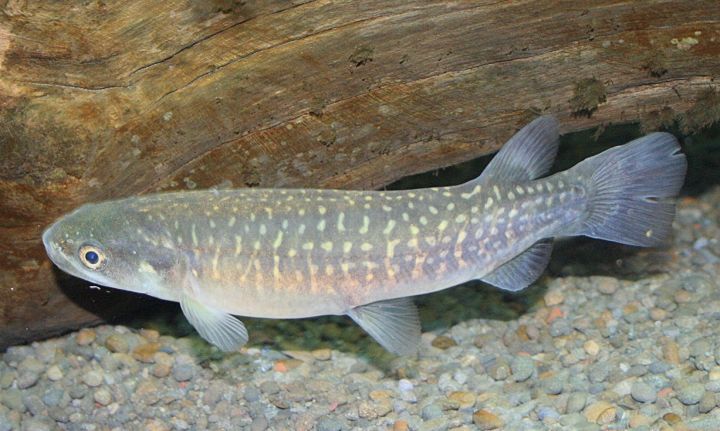
The giant kōkopu is a native whitebait species considered rare and vulnerable. NIWA is working with Mahurangi Technical Institute and environmental consultancy Boffa Miskell to test the feasibility of reintroducing giant kōkopu to Nukumea Stream, north of Auckland.
The issue
The giant kōkopu (Galaxias argenteus) is one of five native galaxiid fish species which, in their juvenile form, make up the whitebait catch. Giant kōkopu is officially recognised as a rare and Nationally Vulnerable species by the New Zealand Department of Conservation.
Giant kōkopu live most of their lives in streams, but hatchlings go out to sea to feed and grow, returning to streams after a few months. It's thought that returning juveniles may be attracted to streams with suitable habitat by chemical signals released by adult giant kōkopu.
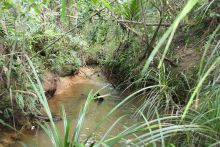
Nukumea Stream, north of Orewa, is considered to be one of the most intact and natural streams within the greater Auckland region. It's thought that giant kōkopu were once common in the stream, but they've been in decline for a number of decades. The last recorded sighting was in 2002.
The decline is thought to be linked to a 'perched' culvert located close to the mouth of the Nukumea Stream. The exit of the culvert was elevated above the downstream water. According to Auckland Regional Council water level data, it formed a barrier to the upstream migration of whitebait for 90% of the time during their annual runs.
The culvert was removed in 2009, eliminating the physical barrier to upstream passage of juvenile giant kōkopu. The concern now is that, with very few adults remaining in the stream, there will be insufficient chemical signals to prompt juvenile migration into the stream and thus re-establish the population. .
More information on giant kōkopu
Our approach
NIWA is working with Mahurangi Technical Institute (MTI) and environmental consultancy Boffa Miskell on a two-year pilot study to test the feasibility of reintroducing giant kōkopu to Nukumea Stream. This will be the first controlled test in New Zealand of reintroducing native fish as a restoration tool.
It's hoped that the reintroduction of young adult giant kōkopu to the stream will help re-establish a self-sustaining population by providing the chemical cues required to encourage natural recruitment. Because fish have to be translocated from outside the catchment to provide the ‘seed’ population, we are undertaking a pilot study to:
- determine whether the translocated fish will survive, and
- make sure there are no adverse effects on existing stream flora and fauna.
The trial release is taking place in a stream reach that contains suitable kōkopu habitat: pools with woody debris and riparian cover. NIWA's baseline surveys recorded eight native fish species in the reach, indicating that there’s a good range and quality of physical habitats, water quality, and flows.
Thirty juvenile fish were released into the reach in December 2009. The fish were hatched and reared to a length of more than 150 mm by MTI. NIWA implanted them with tiny transponder tags, whose signals can be picked up by antennae to monitor how well the fish survive and where they choose to live.
- We’ve installed antennae in the stream to monitor the movement of the fish in and out of the trial reach.
- Monthly surveys will also be carried out for the first six months using handheld antennae to monitor fish habitat use and survival.
- Once a year, we'll carry out a full scale fish survey and catch and measure any fish remaining in the reach to see what condition they’re in, how much they’ve grown, and what habitat they’re using.
This work is being carried out as part of the New Zealand Transport Authority's mitigation programme associated with construction of the SH1 toll road. NIWA's contribution is funded by the Foundation for Science, Research and Technology through the Restoration of aquatic ecosystems project.
More information on the Restoration of aquatic ecosystems project
Future work
If the trial proves successful, with the introduced fish surviving and no detectable adverse impacts on the resident biota, we plan a future release of 500-1000 juvenile giant kōkopu to further boost the population in the stream.
The results
Routine monitoring to date has shown that the stocked giant kōkopu have gradually dispersed from the section of stream where they were released. Records from the fixed antennae indicate that the number of fish detected moving in or out of the release reach each day declined rapidly over the first three months, and that no fish were detected moving in either March or April 2010. Since that time, three different fish have subsequently been recorded passing the fixed antennae at various times, particularly during winter 2010.
It was always expected that the fish would slowly disperse from the release reach in search of food and different places to live. However, we think that the very low flows in the Nukumea Stream during the summer and autumn of 2010 may have accelerated this dispersal. This is because giant kōkopu like to live in deep, slow flowing pools with lots of cover. The very low flows meant that most of this type of habitat disappeared from the release reach, meaning that the fish had nowhere they liked to live. They therefore went off to search for a better home in other parts of the stream.
Unfortunately, this has made tracking the tagged fish down and recapturing them much more difficult, but because we wanted to know how they were getting on, we set some nets in the stream to see if we could recapture some of them.
As of October 2011 we've managed to find two of the tagged fish, both upstream of where they were released. As of October 2011, we have recaptured three of the tagged fish, all living upstream of where they were released. Fish #5510 was found in both August 2010 and January 2011 approximately 500 m upstream of the release reach and fish #6442 was found in January 2011 about 300 m upstream of the release site. In October 2011, fish #5772 was also recaptured in a similar area. All fish were in good condition and had grown about 10-15 mm per year since their release. This shows that they have successfully adapted to living in a natural environment and to finding their own food
Monitoring will continue for the rest of this year before a decision will be made on whether to go ahead with the larger scale stocking of giant kōkopu.
External People Involved:
David Slaven (Boffa Miskell)
David Cooper (Mahurangi Technical Institute)