IceCUBE
IceCUBE: Coastal Underwater Benthic Ecosystems - next field season October 2014.
More information about IceCUBE
First data from weather logging station at Cape Hallett
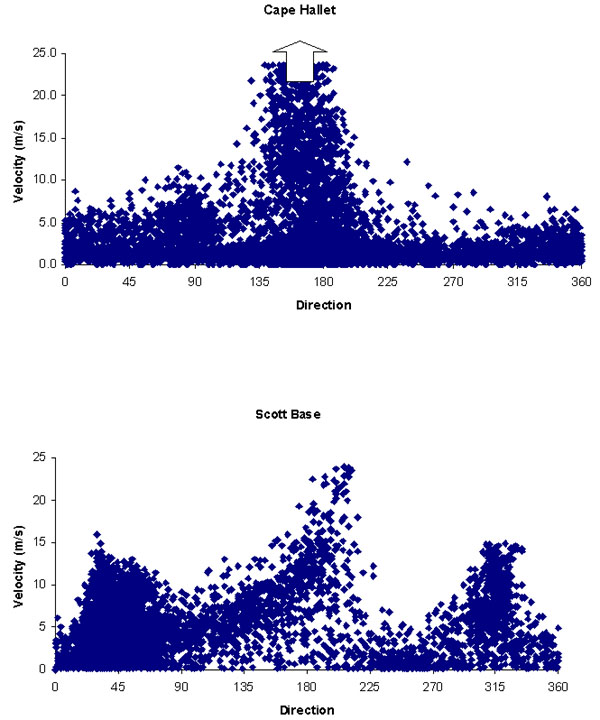
As part of the preparation for Antarctica New Zealand's Latitudinal Gradient Programme (LGP) we deployed a data-logging station at Cape Hallet, towards the northern end of the Ross Sea. Preliminary data show that, as we would expect, conditions at the northern end of the Ross Sea are different to those at the southern end.
Compared to Scott Base, Hallett was on average a bit warmer, though extreme temperatures were just about as low. The big difference was in the wind data – Cape Hallett is slightly windier than Scott Base, and the prevailing wind is from the South. These winds seem to occur as 3-4-day storms, and were seen in both summer and winter. These data allow scientists to understand the likely conditions at Cape Hallett when they are planning their field programmes for the coming years.