
What is a mass spectrometer?
From crime scenes to the bottom of the ocean, scientists are often analysing samples to find out what chemicals they contain, and this often involves a mass spectrometer. But what is a mass spectrometer, and how do they work?
Light can be split by a prism into a spectrum of different colours which take different paths. Mass spectrometers use different physics to produce a similar end result, but with molecules with different masses taking different paths, producing a 'mass' spectrum.
Mass spectrometers use an interesting mix of physics to charge, accelerate and then deflect the path of atoms and molecules. Once an electron is removed from an atom or molecule, they respond strongly to electric and magnetic fields, and are referred to as ions.
Making the ions fly through a strong magnetic field curves their path, but because the force is proportional to the charge, heavier molecules are deflected less, fanning the paths of the ions out similar to the spectrum produced by an prism. Charge sensitive detectors sit at the end of the flight path, and every time an ion is collected it produces a current, which is recorded and used to calculate the ratio of different masses.
If you use a sample with a huge mix of molecules with different masses, it can end up to be almost impossible to work out what a sample is made of. However, with careful preparation samples can reveal an enormous amount.
How NIWA uses mass spectrometers
NIWA uses the ratios of different types, or isotopes, of oxygen to perform a lot of its research. Not all oxygen atoms are the same. The centre, or nucleus of an atom is what makes up the majority of its mass, and consists of protons and neutrons. The number of protons (8) is always the same, but the number of neutrons can vary, and these different varieties are known as isotopes. Although over 99% have 8 neutrons (16O), oxygen also comes with 10 neutrons (18O around 0.2%), and 9 (17 O less than 0.04%). This last one is so rare we'll leave it out of the following example to make it simpler.
Because 18O is heavier than 16O, water molecules (H2O) which contain the 'heavier' oxygen are slightly less likely to evaporate than water comprised of the 'light' oxygen. This means that rain and snow has, on average, a slightly different ratio of 18O to 16O (δ18O) than the ocean. We can detect this small difference with a mass spectrometer. This effect is stronger for the warmer parts of the ocean, which leads to different parts of the ocean having different δ18O ratios, which we can see across the ocean today.
Using δ18O to see into the past
During ice ages, water that evaporated from the ocean preferentially contained 16O and went on to be trapped as snow and ice at the poles, trapping the 16O, which means the overall the ration of 18O in the ocean went up. Because sea creatures use oxygen in their hard parts (shells), it can match the water they live in, and after they die their remains build up on the sea floor, it's possible to see a pattern of different ice ages going back hundreds of thousands of years in sediment cores from the seabed. These changes in δ18O are very small, but modern mass spectrometers are enormously sensitive, they've come a long way since they were invented in 1912.
We can use this information to work out what ocean conditions were like in the past when ancient snow was formed, or what ocean temperatures were like when sea creatures were alive. Both these techniques involve drilling cores deep into glaciers or the sea bed, allowing us to get data ranging back hundreds of thousands of years. There are limits to what can be determined from these kinds of temperature measurements, or proxies, as they are known, but when multiple different proxies agree with each other it greatly increases our confidence in the results.
For example, in younger ice cores you can see lines for each winter's heavier snowfall and count them like tree rings. It's also possible to calculate how much snow fell each year. You can take the same slice of snow and analyse its δ18O ratio, and see that it is opposite the signal in the ocean, i.e. as the 16O is removed from the ocean it ends up in icecaps. Rare events like volcanic eruptions, which can also be dated in a number of other ways, leave ash signals in ice cores and ocean sediments, which means we can increase our confidence in the conclusions we draw from these data.
Carbon 13
Similar work is carried out with isotopes of carbon. Carbon 14 (14C) is famous for its use in dating because it undergoes radioactive decay, and the early parts of ice cores can be be dated in this way. However, there are two non-radioactive, or stable, isotopes of carbon 12C and 13C. These have different effects on chemical and biological reactions, similarly to δ18O, which can tell us about sources of carbon in the atmosphere of the day.
In practice, the samples we work with are usually carbon dioxide, or CO2, which gives us several likely combinations of stable isotopes of carbon and oxygen:
| 16O | 16O | 18O |
| 16O | 16O | 16O |
| 12C | 13C | 12C |
| 44 | 45 | 46 |
This means we can discover information about the temperature of ancient oceans and the sources of ancient carbon in carbon dioxide from the samples of CO2 from air trapped in different parts of an ice core. This allows us to see how ocean circulation patterns, carbon sinks and a whole host of other systems changed as previous ice-ages came and went over hundreds of thousands of years. This will help predict how adding greenhouse gases to the atmosphere today will go on to affect the earth in future.
Are there icebergs around New Zealand?
Life cycle of an iceberg
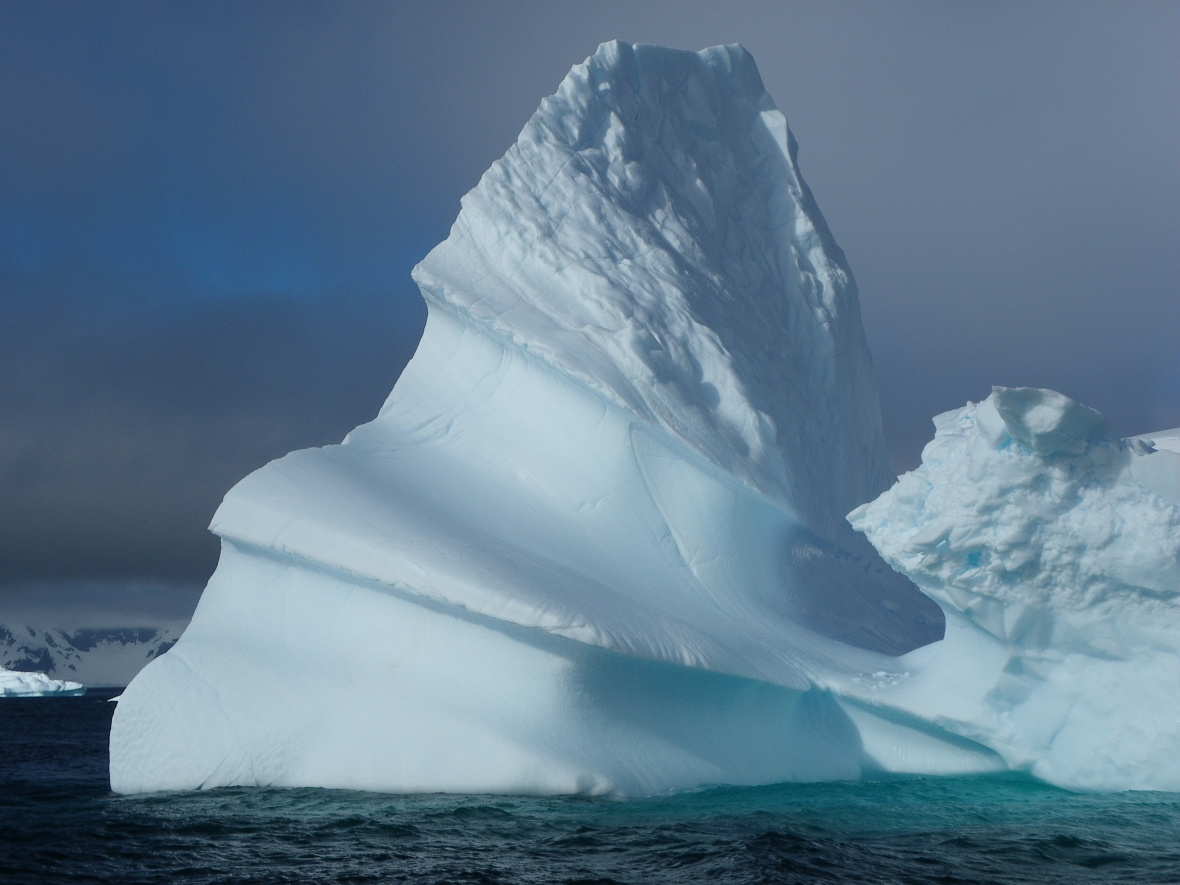
Icebergs are biggest when they calve from the ice shelf. After that, the sun and the ocean start to melt the iceberg. Waves erode its sides and small pieces of ice constantly break off. But perhaps the most dramatic way that icebergs get smaller is by splitting, from waves flexing the iceberg, or losing their rams. Rams are portions of an iceberg that jut out horizontally from an iceberg underwater. These can break away and surge to the surface under their own buoyancy. An iceberg’s route is determined by the action of wind, waves, and ocean currents. When icebergs are large the ocean currents are the most important in determining their direction. As the icebergs get smaller, the wind and the waves become more important.
Icebergs around New Zealand
Icebergs approach New Zealand’s sub-Antarctic islands every few years. The closest they have come to New Zealand was in November 2006 when they were off the coast of Otago and Canterbury coast for over a month. Prior to 2006 the last sighting from the mainland was off Dunedin in 1931. We know icebergs have been visiting New Zealand for a long time. NIWA has identified scour marks in the sea floor on the Chatham Rise, which were probably left by icebergs during the last Ice Age 20 000 years ago.
The 2006 icebergs originally came from one of six large icebergs that calved from the Ross Ice Shelf near New Zealand’s Scott Base, between 2000 and 2002. The largest of these, B15, was initially 295 km long by 38 km wide. On their journey to the New Zealand the icebergs will have drifted along the western coast of the Ross Sea, before spending years grounded in one of Antarctica’s “iceberg graveyards”. After escaping from the graveyards by breaking up and melting they resumed their northward journey crossing the Southern Ocean in around 7 months. Near New Zealand, the icebergs came between the Auckland Islands and Stewart Island, instead of taking the more usual path to the southeast and out in to the Pacific Ocean. By the time they were east of Stewart Island the original large iceberg had broken into an armada of smaller icebergs, the largest of which was over 500 m long and 300 m when first seen. Although most of the iceberg is under water it’s likely to have been up to 350 m thick, with about 300 m under water. From here most of the icebergs headed away from New Zealand, but some made it into the Southland Current. This current runs up the east coast of the South Island to about Banks Peninsula, before heading towards the Chatham Islands.
It is likely the icebergs currently near Macquarie Island have a similar origin to those that made it to New Zealand in 2006, but have been trapped in the “iceberg graveyards” for longer. So far they have made it most of the way across the Southern Ocean, but there remains the possibility that like most icebergs near New Zealand they will be pushed east by the main Southern Ocean current, the Antarctic Circumpolar Current, out into the Pacific Ocean.
What is ocean acidification?
Ocean acidification is the name given to the lowering of pH of the oceans as a result of increasing carbon dioxide (CO2) in the atmosphere. The pH of the ocean is determined by the level of hydrogen protons (H+) in sea water. The lower the pH, the more acidic the ocean.
The carbonate buffer system
For the last 750,000 years the pH of the surface ocean has been relatively stable and slightly alkaline at 8.2 due to the carbonate buffer system. This is a series of reactions, in which dissolved CO2 is converted to bicarbonate using carbonate as a buffer, that has kept the level of H+ protons (and therefore pH) constant.
Effects of increased carbon dioxide
The amount of CO2 entering the surface ocean has increased over the last century and exceeded the natural replenishment rate of carbonate, with the result that the H+ has increased, making the water more acidic. The pH of the ocean is estimated to have decreased by 0.1 pH units (a 25% increase in H+) since the start of the Industrial Revolution. It’s predicted to decrease by a further 0.3 pH units by 2100.
Impacts of ocean acidification on marine life
The impacts of ocean acidification have only recently begun to attract scientific attention. Scientists are particularly concerned about the survival of organisms that have shells composed of carbonate, as it becomes more difficult to grow and maintain carbonate in a more acidic ocean. This will affect a diverse range of organisms including corals, phytoplankton and zooplankton, algae and molluscs such as shellfish.
Possible effects on organisms with carbonate shells are:
- chronic effects, such as reduced growth and reproduction
- acute effects, such as high mortality
- adaptation, where the organisms are able to adjust to the new pH.
It’s currently unclear which of these will occur.
Organisms without carbonate shells may experience:
- physiological effects, such as hypercapnia, which is CO2-induced acidification of the blood and other body fluids
- indirect effects, from loss of food or habitat.
Conversely, increased dissolved CO2 may benefit certain groups of phytoplankton and algae, boosting their growth rate and productivity.
Although it is likely that there will be significant changes in productivity, diversity, and distribution of different groups as a result of ocean acidification, we are unable to predict these with our current state of knowledge.
How do we identify new aquatic species?
First we must be able to recognise if a species is new to science. There are several steps to the process.
Sorting and storing specimens
The techniques used depend on the type of specimen, for instance:
- large animals can be sorted by eye or low magnification
- micro-organisms, such as bacteria and viruses, may require high magnification and culturing.
Different approaches are also needed for different environments, such as deep marine, shore, and freshwater.
As an example, when marine life is collected by ship-board sampling from the continental shelf or deep sea it mostly comes on board as a mixed-up heap of animals, mud, sand, and some rocks. It has to be washed and sorted on board and representative samples preserved (sometimes frozen).
That initial sorting separates the catch into major categories like sponges, sea anemones, worms, crustaceans, shellfish, sea stars, fish, and so on. Back at NIWA, the preserved specimens may then be further sorted into apparent species, put into jars of alcohol, and registered into the NIWA Invertebrate Collection.
Comparing characteristics
Different groups of organisms need trained specialists (taxonomists) to distinguish a new species from one that is already named and scientifically described. If a taxonomist is not sure, the specimen has to be examined in detail and compared with other known similar species. Physical characteristics are compared using keys, descriptions, and illustrations in published literature. Taxonomists may also analyse genetic characteristics to separate species that look very similar.
Formal naming and describing
Once they determine that a species really is new, the taxonomist writes a formal description, makes photographs and illustrations, and invents a new name for it. They then submit a scientific paper describing it (usually with several other new species) to a scientific journal. The journal editor sends the draft paper to two or three other experts in different parts of the world. If they agree that the species is new they recommend formal publication.
Taxonomists at NIWA
There are more groups of marine and freshwater life than there are experts for them in New Zealand. NIWA has world authorities who specialise in several groups and some in our taxonomy team are being trained for other groups. Overseas experts are frequently invited to assist the team with identification and description of the other forms of marine life.
What is an invasive sea squirt?
The invasive sea squirt, Styela clava, has been found in New Zealand. This invasive sea squirt is known by many names. Its scientific name is Styela clava Herdman, 1881. It is also known as the club tunicate, clubbed tunicate, Asian sea squirt, leathery sea squirt, or Pacific rough sea squirt.
What are sea squirts?
Sea squirts are immobile marine invertebrates which extract food (plankton and organic material) from seawater pumped through a branchial sac in their body cavity. They are called sea squirts because they ’squirt' seawater.
The scientific name for this class of animals is Ascidiacea, so scientists often refer to them as 'ascidians'.
They are part of a wider grouping (sub-phylum) of marine invertebrates called 'tunicates'.
What are the key features of Styela clava?
Styela clava has a long, club-shaped body on a tough stalk. Its surface is tough, leathery, rumpled, and nobbly. They can be brownish-white, yellowish-brown, or reddish-brown. In sum: ugly brutes.
Scientists call Styela clava a ’solitary' sea squirt, which means that each individual has its own stalk and adheres separately to a substrate.
It is known to grow rapidly overseas, reaching densities of up to 500-1500 individuals per square metre. They can live for up to two years and grow up to 160 millimetres long.
Styela clava is a hermaphrodite, but you have to have more than one to reproduce because the male and female sex organs mature at different times to avoid self-fertilisation. They release eggs and sperm into the water, where eggs are fertilised. The resultant larvae can float freely for 1-3 days before settling and attaching themselves to a hard surface (e.g., rocks, wharf pylons, marine farm ropes).
Overseas studies have shown Styela clava to be reproductive throughout much of the year. It does not reproduce when the water temperature is below 15 degrees Celsius.
What conditions does Styela clava like?
Styela clava lives in mostly in shallow seawater and can live in water as deep as 25 metres.
It has been suggested that it can survive in water temperatures ranging from 2 degrees Celsius to 23 degrees Celsius.
What damage does Styela clava do?
The sea squirt competes for space and food with native and aquaculture species (e.g., mussels, oysters).
It can also be a nuisance by fouling marine farming lines, vessel hulls, and other structures.
Where is Styela clava found around the world?
Styela clava is thought to be native to the northwest Pacific: Japan, Korea, Northern China, and Siberia.
It is known to have spread to parts of northwestern Europe, North America, and Australia (northern Tasmania; southern New South Wales and Victoria).
How does Styela clava spread?
Styela clava has probably spread round the world on ships' hulls and possibly on oysters transferred from one place to another.
For example, in 1953, Styela clava was found in Plymouth Devon, UK. This has been linked with the return of war ships there at the end of the Korean War in 1951.
Can Styela clava be controlled?
Hand removal (picking or scraping the organism from its point of attachment) is the most reliable control method, but this is obviously costly in terms of time and effort. Other ways of killing Styela clava involve lengthy exposure to air and/or extreme temperatures. Sprays and dips of high salt, hydrated lime, and acetic acid solutions have also been tried on tunicates.
Adult Styela have tough leathery bodies and may contain chemicals that deter predators. The tiny 1-3 day old juveniles are vulnerable to specialised predatory snails in some locations. There are reports of predation by certain fishes (wrasses) in the northeastern US. According to the UK Joint Nature Conservation Committee, the deliberate introduction of the common shore crab (Carcinus maenas) into cages surrounding the sea squirt was not successful as a control agent.