About this service
Broodstock development is a core requirement where the production system does not rely on wild-sourced juveniles. It combines environmental science, animal behaviour, nutrition, health management and genetics to ensure consistent, cost-effective supplies of healthy, high performing juveniles for on-growing.
One of NIWA's core areas of research and consultancy services are the broodstock development of aquaculture species and breeding strategy. Selective breeding programmes cannot be viewed or pursued in isolation. Desired trait selection is defined by the market and by the production system.
At the onset, it is valuable to determine the genetic variability within a population and the scope of potential performance in key traits such as growth rates, the timing of maturation, feed use efficiency or tolerance to anticipated environmental extremes.
NIWA has a robust broodstock development platform. While we have demonstrated our capability on a wide variety of species in the past, we recognise the significant costs associated with successful broodstock development and acknowledge the importance of identifying a realistic route to commercialisation before investment.
Our services
Our team can help you with all aspects of broodstock development and management, from acquisition, set-up and advice on nutrition and husbandry of new brood, right the way through to detailed troubleshooting and managing the genetic make-up of your existing broodstock to optimise performance to meet your business needs.
The range of facilities and expertise available allows for a wide range of bespoke trials to fit your need (e.g., nutrition trials, hormonal induction, RAS vs flow-through, etc). This includes conducting replicated long term trials in large tanks to answer specific research questions.
Our facilities
- Hatchery laboratory for microscopy, sample processing and analyses
- Ten 20,000 L outdoor tanks
- Photothermal controlled broodstock rooms consisting of:
- 4 x 20,000 L tanks
- 3 x 20,000 L tanks and 1 x 40,000 L tank
- 2 x 20,000 L tanks and 1 x 40,000 L tank
- 1 x 70,000 L tank
- Photothermal controlled egg incubation rooms consisting of:
- 16 x 400 L conical tanks
- 32 x 400 L conical tanks
Our expertise
- Reproductive biology, broodstock husbandry, nutrition and spawning advice
- Development of broodstock management and selection plans appropriate for the resources available and individual goals of the farmer
- Breeding programme design and implementation protocols
- Development of methods for the accurate analysis of commercially valuable traits
- Genetic evaluation of performance traits and selection index development
- Application of techniques such as hormone induction to enhance broodstock management and selection
Selected track record
Through our research on reproductive biology and behaviour, we can reliably produce multiple generations of captive-bred hāpuku and kingfish, the latter at a commercial scale.
We combine fecundity and fertility analysis, progeny performance testing and selective breeding to establish high-performance hāpuku and kingfish broodstock. In conjunction with commercial partners, we apply these techniques and selective breeding and genetic technologies (parentage analyses and genomics) to enhance the performance of established species such as Chinook salmon, and Pāua (abalone).
Yellowtail kingfish (Seriola lalandi)
Our research has enabled us to reliably manipulate kingfish to spawn on-demand providing a year-round supply of juveniles for commercial on-growing or research. This controlled breeding has permitted us to conduct individual family crosses.
We have used DNA markers to accurately determine parentage and track family performance and select elite animals for future breeding. Analysis of performance data illustrates the potential for genetic gains from selective breeding in this species.
We have demonstrated that conservative elite family selection for rapid growth can result in a 20% improvement in growth rate per generation.
Hāpuku (groper, Polyprion oxygeneios)
Intensive research on broodstock husbandry and hatchery technology for hāpuku has allowed us to close the life-cycle of this species for aquaculture. We now have a reliable yearly production of second-generation fish; a world’s first for this family of fishes.
We hold over forty hāpuku families for performance evaluation and broodstock selection. We developed a proven protocol for hormonal induction to spawn pre-reproductively competent hāpuku broodstock.
Performance assessments include fish health, survival rates, appearance, feed use efficiency and growth. Analysis of that information tells a similar story to our kingfish; a conservative elite family selection for rapid growth (10%) would result in generation over generation growth rate gains of 25%.
Paua (abalone, Haliotis iris)
NIWA scientists developed techniques for hatching abalone in the 1980s and have established multiple family lines to determine the heritability of key performance traits. For example, from our analysis of growth traits, we estimate performance can be improved by as much as 10–20% per generation.
We work closely with Moana New Zealand Blue Abalone in managing the farmed broodstock and to continually improve their performance.
Chinook salmon (Oncorhynchus tshawytscha)
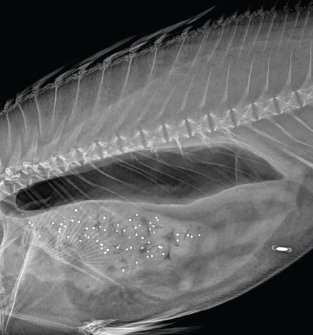
X-radiography feed intake and feed efficiency studies have demonstrated that feed efficiency is heritable, independent of growth rate, and can be improved through selective breeding.